Showing posts with label parenting. Show all posts

Monday, July 23, 2007

the joy of a crazy playdate

i openly admit that i cringe at the idea of playdates.  so often it seems that a playdate becomes a platform for competition and judging other mothers and their parenting skills.  for over 2.5 years i have avoided most playdate opportunities like the plague because of this bizarre behaviour.

today, thanks to a wonderful lady named Dani, over at www.mom2mom.ca/toronto india, kalden and i went to the biggest playdate ever and it was nothing at all like my previous experiences.

at one point i counted 24 kids in Dani's backyard but i know there were even more kids in the house.  it was pure madness and i loved every minute of it.

everywhere i looked, someone was holding someone else's baby, wiping mud off someone else's toddler and getting food for someone else's child.  it was beautiful to watch strangers become friends with nothing more in common than the fact that they were parents.

today was the perfect example of how things "should" be.  laughter, smiles and co-operation in parenting.  bonding over tortilla chips or the smell of a new baby is a much better way to live life than spending time worrying about who is potty trained and who is counting to 10. 

i even got to chat with a fellow doula, although it was a little hard to have a continuous conversation when there was so much action around us.

i REALLY look forward to meeting up with more of those ladies and having the chance to get to know them better on an individual basis.  i am also really thankful for online communities like mom2mom that translate into wonderful "in real life" experiences. 

Monday, July 16, 2007

the evolution of breastfeeding

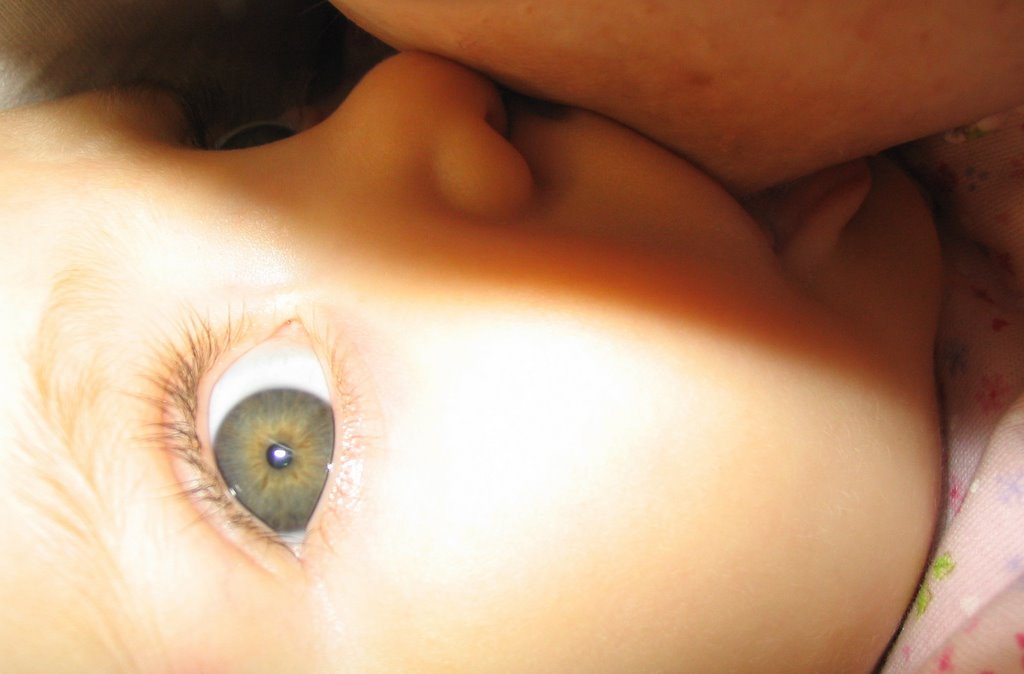
when i had my daughter 2.5 years ago, i knew that i was going to breastfeed her.  there was no alternative in my mind and i never for one second considered that it might not work out. 

i was lucky.  india latched on like a professional within minutes and was breastfed until she was 18 months old.  i didnt really realize at the time that i was being political in any way; i was just feeding my baby.

i remember feeling slightly uncomfortable as i tried to feed her in a crowded waiting room, or feeding her in the car in a parking lot trying to make sure i was sufficiently covered up.  as india aged i felt even more self conscious and of course, i was faced with questions from family and friends about when i was going to stop breastfeeding my child.

we went on vacation when india was 13 months old to a colombian island in the caribbean and suddenly women everywhere on the island were smiling and nodding whenever i breastfed my daughter publicly.  these subtle approvals were warm and comforting and most importantly they reassured me that i was was doing a GOOD THING for my child. i went on to breastfeed her until she self weaned and i felt good about my accomplishments.

now that i have a son, i am much more confident when breastfeeding and i don't care where i am or who is in the room.  when my child needs to eat, i happily feed him.  i'm less concerned about covering up and making sure nothing is showing.  and you know what?  no one seems to mind one bit. 

so while i realize that what i'm doing is considered political - more importantly, it's just a human act of love.  and since my 4 month old weighs 19 pounds, it seems to be working out perfectly.  :)

Thursday, July 5, 2007

the myth of mommy guilt

everywhere i go online i see postings or articles about "mommy guilt" and why we shouldn't feel guilty about the choices we make for our kids.

it's all nice and sweet and leans towards patting everyone on their back about what a great mommy they are. well i'd like to challenge this whole notion of "mommy guilt".

if your kid is watching 4 hours of tv a day - then you SHOULD feel guilty. it doesn't make you a terrible mom but you should address the TV issue.

if you feed your kid mcdonalds 3 times a week then you should feel guilty. and stop taking them to mcdonalds!

as a personal example, last week i put kalden (my 4 month old) in his carseat and placed him on a stool. the whole thing toppled over and kalden fell. it was horrible and horrifying and thankfully he was fine but it was MY mistake and i felt guilty about it. and that's OKAY.

i will be more careful next time.

so i'm not a big fan of the sentiments that tell us that all out kids will end up the "same" by high school and to stop feeling guilty for the choices we make now when they're little. only YOU can take responsibility for your choices and so you as a parent should make them carefully. we all make mistakes. it's part of being human. but the whole "say no to mommy guilt" trend is just a cop out to make us all feel better about those bad choices and it gives us an excuse to keep making them.

i support making informed choices and learning about what it best for your own family. then stand by those decisions. and if you made a mistake, then feel a bit guilty and move on. it's FINE.

Tuesday, June 26, 2007

delaying solids...


i know the temptation to give your 4 month old some rice cereal or pureed carrots. believe me, i understand how cute it is and how much fun it is to see witness their first attempts at eating "food". but please stop yourself! hold on... a baby doesn't NEED solids and actually is BETTER OFF without them for the first 6 months of life. the benefits of delaying solids until 6 months far outweigh the "cuteness factor" of feeding a 4 month old something his or her body isn't ready for.

and while we're at it, did you know that the la leche league does NOT recommend that cereal be your babies first food? instead of a highly processed food, they recommend starting with fesh fruit and veggies like avocado or banana. and again, they reccomend this starting at 6 months of age and not before.

from kellymom.com:

Reasons for delaying solids

Although some of the reasons listed here assume that your baby is breastfed or fed breastmilk only, experts recommend that solids be delayed for formula fed babies also. Delaying solids gives baby greater protection from illness. Although babies continue to receive many immunities from breastmilk for as long as they nurse, the greatest immunity occurs while a baby is exclusively breastfed. Breastmilk contains
50+ known immune factors, and probably many more that are still unknown.

One study has shown that babies who were exclusively breastfed for 4+ months had 40% fewer ear infections than breastfed babies whose diets were supplemented with other foods. The probability of respiratory illness occurring at any time during childhood is significantly reduced if the child is fed exclusively breast milk for at least 15 weeks and no solid foods are introduced during this time. (
Wilson, 1998)

Many other studies have also linked the degree of exclusivity of breastfeeding to enhanced health benefits (see
Immune factors in human milk and Risks of Artificial Feeding).

Delaying solids gives baby's digestive system time to mature.
If solids are started before a baby's system is ready to handle them, they are poorly digested and may cause unpleasant reactions (digestive upset, gas, constipation, etc.). Protein digestion is incomplete in infancy. Gastric acid and pepsin are secreted at birth and increase toward adult values over the following 3 to 4 months. The pancreatic enzyme amylase does not reach adequate levels for digestion of starches until around 6 months, and carbohydrate enzymes such as maltase, isomaltase, and sucrase do not reach adult levels until around 7 months. Young infants also have low levels of lipase and bile salts, so fat digestion does not reach adult levels until 6-9 months.

Delaying solids decreases the risk of food allergies.
It is well documented that prolonged exclusive breastfeeding results in a lower incidence of food allergies (see
Allergy References and Risks of Artificial Feeding). From birth until somewhere between four and six months of age, babies possess what is often referred to as an "open gut." This means that the spaces between the cells of the small intestines will readily allow intact macromolecules, including whole proteins and pathogens, to pass directly into the bloodstream.This is great for your breastfed baby as it allows beneficial antibodies in breastmilk to pass more directly into baby's bloodstream, but it also means that large proteins from other foods (which may predispose baby to allergies) and disease-causing pathogens can pass right through, too. During baby's first 4-6 months, while the gut is still "open," antibodies (sIgA) from breastmilk coat baby's digestive tract and provide passive immunity, reducing the likelihood of illness and allergic reactions before gut closure occurs. Baby starts producing these antibodies on his own at around 6 months, and gut closure should have occurred by this time also. See How Breast Milk Protects Newborns and The Case for the Virgin Gut for more on this subject.

Delaying solids helps to protect baby from iron-deficiency anemia.
The introduction of iron supplements and iron-fortified foods, particularly during the first six months, reduces the efficiency of baby's iron absorption. Healthy, full-term infants who are breastfed exclusively for periods of 6-9 months have been shown to maintain normal hemoglobin values and normal iron stores. In one study (Pisacane, 1995), the researchers concluded that babies who were exclusively breastfed for 7 months (and were not give iron supplements or iron-fortified cereals) had significantly higher hemoglobin levels at one year than breastfed babies who received solid foods earlier than seven months. The researchers found no cases of anemia within the first year in babies breastfed exclusively for seven months and concluded that breastfeeding exclusively for seven months reduces the risk of anemia. See
Is Iron-Supplementation Necessary? for more information.

Delaying solids helps to protect baby from future obesity.
The early introduction of solids is associated with increased body fat and weight in childhood. (for example, see
Wilson 1998, von Kries 1999, Kalies 2005)

Delaying solids helps mom to maintain her milk supply.
Studies have shown that for a young baby solids replace milk in a baby's diet - they do not add to baby's total intake. The more solids that baby eats, the less milk he takes from mom, and less milk taken from mom means less milk roduction. Babies who eat lots of solids or who start solids early tend to wean prematurely. Delaying solids helps to space babies. Breastfeeding is most effective in
preventing pregnancy when your baby is exclusively breastfed and all of his nutritional and sucking needs are satisfied at the breast.

Delaying solids makes starting solids easier.
Babies who start solids later can feed themselves and are not as likely to have allergic reactions to foods.

Sunday, June 24, 2007

pride in toronto

today was the annual gay pride parade in toronto. i love celebrating pride and i love it more that i can celebrate it with my kids. it's not the easiest task to get a 3 month old and a 2.5 year old ready for a day with 30 degree heat and 1 million spectators. usually there is a large group of us going down together but this year it was just me and my sister. so we braved it alone.


funny enough, not long after we arrived downtown a reporter from the Globe and Mail stopped me to ask me a few questions about attending pride with children. it was a quick interview and i'll be curious to see if anything i said makes it to print. i'll have to remember to check the Globe tomorrow.

sadly my daughter slept through almost the entire parade and missed out on all the fun. of course now i have to deal with the litany of questions about where the parade went! she woke up just in time to get back on the subway and head uptown. maybe next year she'll get to play in the children's area at the Church St. school.

happy pride toronto!


Wednesday, June 20, 2007

how fast can you type?

it's happened. both kids are asleep. the panic sets in. where do i start? how much can i get done? my hair needs washing but that's not as important as cleaning out the smelly food in the fridge. but the fish tank has some algae issues. wait i need to send some emails for my dad. crap i think a baby has woken up.... all i got done was posting this blog.

Tuesday, June 19, 2007

extended breastfeeding?

this is an old post from a blog i wrote for a while in 2005... i ended up breastfeeding my daughter until she was 18 months and she self weaned. i hope to make it to 2 with my son.

on the eve of some good friends having a beautiful baby boy, i was thinking about the term "extended breastfeeding" and how innacurate the term actually is. extended breastfeeding, in north american terms, mean breastfeeding past one year of age. however the World Health Organization recommends babies be breastfed up to two years of age.

As a global public health recommendation, infants should be exclusively
breastfed
1 for the first six months of life to achieve optimal growth, development and health.2 Thereafter, to meet their evolving nutritional requirements, infants should receive nutritionally adequate and safe complementary foods while breastfeeding continues for up to two years of age or beyond.
therefore, should the term "extended breastfeeding" not be applied until a baby is older than 2?

nothing is more sad than the lack of education and support in north america regarding just how vital breastfeeding is for babies. women who can't breastfeed shouldn't be made to feel bad, there shouldn't be guilt in bottlefeeding but there should be way women doing it. that might seem like a contradictory statement but in my opinion if everyone made a honest effort to breastfeed their children, then the few who couldn't would not feel bad about it and no one would question their situation. as it is now, i constantly hear about women whose breastfeeding attempts were sabotaged by nurses, jealous husbands, mothers and other relatives. and in the end the baby is the one getting the raw deal.

my daughter will be one on february 1st and i DO NOT consider myself to be extended breastfeeding. i consider myself to be taking care of my child's natural needs. our nursing sessions are something sacred in this family and i'm lucky to have a husband that comes from a country where breastfeeding until 2 or 3 is the norm...just for a refresher, here's a great article on the benefits of breastfeeding.

links on the benefits of "extended breastfeeding"

http://www.lalecheleague.org/NB/NBextended.html

http://www.kellymom.com/bf/bfextended/ebf-benefits.html

http://www.gentleparenting.com/ebf_faq.html

Monday, June 18, 2007

in defense of co-sleeping

InFact Canada released this response to the Ontario Coroner's report which slammed co-sleeping as dangerous.

Thanks to Dani at mom2mom for sharing this.
.
Last week, Ontario’s deputy chief coroner James Cairns released a widely-publicized report which strongly recommended that parents not sleep in the same bed with their infant children. “We are opposed to co-sleeping, period,” said Cairns.

"The only safe sleeping environment is in a properly manufactured crib with a proper mattress and nothing in it."

Cairns is much too quick to condemn co-sleeping, a normal nurturing tradition that is practiced by the majority of mothers around the globe and has been proven to be beneficial for infants.

The coroner based his conclusions on only 11 infant deaths in 2005 which were attributed to sharing a bed with a parent or sibling. However, at least six of these deaths involved parents who were intoxicated by alcohol or marijuana. Given that over half the deaths attributed to co-sleeping involved other dangerous factors, a wholesale condemnation of bed-sharing is hardly justified. Instead, the coroner should have outlined safe co-sleeping practices, which include never bed-sharing if a parent’s ability to be roused by the infant’s cues is impaired by intoxication, medication, or extreme fatigue.

The coroner’s report is a disservice to Ontario’s families. The importance of co-sleeping is well-documented and substantial. Significantly, during the first few days after birth, co-sleeping allows for immediate breastfeeding and skin-to-skin contact between mother and baby, which helps to regulate an infant’s heart beat, sleep patterns, and body temperature.

Despite popular myths about the repercussions on children of sharing a bed with parents, studies indicate that infants who co-sleep grow up to have higher self-esteem and less guilt and anxiety. Sleeping next to an infant allows a mother to respond better to her baby’s cues. Research has shown that this increased responsiveness can reduce incidences of Sudden Infant Death Syndrome (SIDS).[1]

Co-sleeping also facilitates breastfeeding. Many mothers have reported deriving great pleasure and comfort from being able to wake up during the night when their nearby baby wants to suckle, and then falling asleep together once the child is full. Co-sleeping allows infants to breastfeed whenever they need to, usually 2-3 times a night.[2]

That’s more often than crib-sleeping babies, who may not get to feed when they need to.

Aside from providing an infant with optimal nutrition, breastfeeding has been shown to reduce the incidence of SIDS. Breastfed infants are much less likely to die from SIDS than are bottle-fed infants.[3]

Co-sleeping is part of the normal mother baby relationship and can be done safely. Parents should be made aware of the proper precautions they need to take when sharing a bed with their infant. But outright condemnation of the practice is simply not responsible, especially when it is known that bed-sharing can confer many important benefits to mother and child.

Sunday, June 10, 2007

co-sleeping safely

all week, thanks to Ontario's coroner's report, we've been bombarded with headlines like this:

Does co-sleeping kill?
Dangers of 'co-sleeping
Every parent should know: Co-sleeping kills
Coroner Warns Parents: Don't Take Baby To Bed

first my mother mentioned it - then my husband came home asking me if this stuff is true. i'm at the point where i want to scream! let's examine this a bit closer; the coroner says that co-sleeping is unsafe because last year co-sleeping was attributed to 11 out of 21 "sudden unexpected death syndrome". What the media HASN'T picked up on is that the vast majority of those deaths were ACTUALLY attributed to the co-sleeping parent being intoxicated, heavily medicated, using drugs or other unsafe practises. the act of co-sleeping is not the problem, it's a practise considered normal in most of the world.

Let's just go back to the numbers for a minute. 11 of 21 deaths. so just over 50% right? and where, you might ask were the other deaths? most of them were in a CRIB. so is anyone saying that a crib is unsafe? of course not. because those crib deaths were attributed to unsafe crib practises. having an overcrowded crib is as dangerous as falling asleep drunk with your baby in your arms.

i co-sleep with my babies for the first 6 months. i believe it's not only better for my children's emotional and mental health but i strongly believe that it's safer. i believe in instinctual parenting and my instincts tell me to keep my babies close. and research agrees. studies have shown that co-sleeping babies gain more weight, have lower SIDS rates and that mom ends up with better mental health.

here is a site with great links about co-sleeping:

http://www.cosleeping.org/

Guidelines for Sleeping With Your Baby

  • Always place baby to sleep on their back.
  • Baby should sleep next to mother, rather than between mother and father.
  • Take precautions to prevent baby from rolling out of bed. Use a mesh guardrail and be sure the guardrail is flush against the mattress and fill in any crevice with a rolled-up baby blanket or towel.
  • Use a large bed with a mattress that fits snugly against the rail or is flush up against a wall.
  • Don't use fluffy bedding or cover baby with comforters, etc.
  • Do not sleep with your baby if you are under the influence of alcohol, drugs, or sleep-inducing over-the-counter medications or if you are overly exhausted from sleep deprivation
  • Do not allow baby-sitters or older siblings to sleep with baby.
  • Don't fall asleep with baby on a couch, bean bag chair or waterbed.
  • Do not let baby sleep unattended on an adult bed.
  • Don't overly bundle baby, because they get additional warmth from the mother's body. Overheating can be dangerous to infants.